Showing posts with label humility in leadership. Show all posts

Friday, July 29, 2011

Should others follow your lead?

Should others follow you? Is your leadership worth following? If the world acted and did as you do, would the world be a better place?

Consider the example you set for your family, particularly your kids. Would you be proud if they acted the same as you?

Reflect on your driving habits; do they exemplify what you would like to see in other drivers?

The greatest leaders are not those that are the loudest, who stand out among the crowd with grandiose personalities, but rather the meek, mild and most considerate. They are not pushovers, but instead stay on course and seem to do the right thing without inflicting causalities along the way. They treat others as they themselves would like to be treated.

I believe that the greatest leaders this world has and will see are those that we don't name or write books about. They remain behind the scene, out of the limelight and set the example for all to follow. They seem to follow this principle:

Be of the same mind toward one another; do not be haughty in mind, but associate with the lowly. Do not be wise in your own estimation. Never pay back evil for evil to anyone. Respect what is right in the sight of all men. If possible, so far as it depends on you, be at peace with all men. Romans 12:16-18

Our actions speak louder than our words.


Share/Save/Bookmark

Sunday, May 8, 2011

The cost of arrogance

If you live in Canada, you are aware that we just completed a federal election. Canadian politics in general including the election campaign provide vast amounts of leadership subject matter. The most illuminating is the reason for this election in the first place.

One man’s dream

The recent Canadian federal election was in reality, about one man’s dream. This man “an elegant and fine minded individual,” as described by a member of his party, believed that he was destined to be the leader of this great country. This election was about the perceived entitlement of Michael Ignatieff, the leader of the Liberal party of Canada who said "let us dare to dream but let us also dare to act," and history now shows us the he did both.

Perhaps it was his 34-year absence from this country, writing and teaching – indoctrinating – other fine young minds in prestigious colleges, which created this impression within that he should be our leader. Regardless of reason, the fact is that despite all evidence to the contrary, Ignatieff thought “he” could win and triggered an election. This decision caused decimation in the Liberal party popular vote and seat count in parliament, with numerous long term MPs losing their seats including Ignatieff himself.

Humility is foundational to effective leadership, and as perfectly demonstrated in Canadian politics, arrogance usually results in the incapability to face the brutal facts. We see the problem with the conceited, proud, egotistical leader far too often, and other than “don’t make them a leader,” I am not sure how to correct.

For the self-important, high and mighty individual – the cure, the fix - is failure. You only had to watch Michael Ignatieff walk up to the podium to announce his retirement from politics to return to teaching to realize that his pride level has experienced a major correction.

Final thought: While I am not happy with the $300 million Michael’s dream cost Canadian taxpayers – I am happy with the final outcome. This time it was worth the expense.

If you disagree with any of this – you might be a liberal.


Share/Save/Bookmark

Friday, September 4, 2009

We should never question leadership – should we?

Valkyrie movie posterThe movie Valkyrie (2008) increased my faith in human beings. I never quite understood how an entire nation under the leadership of one man could carry out such horrific acts. The film, based on actual events, is about a plot to assassinate Hitler during the height of WWII. Through this film, I learned that this was only one of many failed attempts to eliminate Hitler.

Under Hitler, the majority simply obeyed and executed their orders with excellence completely ignoring any conscience or moral convictions that were within them. They did things right. A small minority of men and women did everything they could to stop the atrocities – many giving their lives in the process. This would have been incredibly hard to do drawing upon unimaginable courage. They did the right thing.

Great leaders stand by their convictions and do not compromise their values, beliefs and integrity – they will question and / or oppose decisions that they believe are wrong.

The world is a dangerous place, not because of those who do evil, but because of those who look on and do nothing. Albert Einstein

Of course, most of us will never face the life and death decisions like those described above, but the same principles apply to everyday leadership / management decisions. The cornerstone of leadership is humility. Leaders that exhibit humility are also prepared to accept questions or challenges themselves from those who are following them.

The next time someone constructively questions a decision or direction, be sure to value his or her courage for asking, to the extent, that he or she would not hesitate to do it again in the future.


Share/Save/Bookmark

Monday, August 17, 2009

Suggestion programs cut both ways

Early in my working career, I was introduced to the "Employee Suggestion Program". I thought it was great. The idea that I could submit my ideas to help improve the company for consideration provoked me to continuously look for them [new ideas]. I sent a few in. One of them, a simple invention to help make a process easier, actually rewarded me with a $25 gift certificate. I was 17 years old, and the power that this "Suggestion plan" provided me, had a profound impact. It made me feel like a partner in the business. It kept me engaged. Sadly, the organization for which I worked, terminated the program - a very poor decision.

Whether your employees are 17 or 50 years old, a suggestion program is a great method for soliciting the great ideas that are within the loyal employees of your company. These kinds of programs – used properly - make everyone feel like a partner, and help to engage the entire organization. However, these can't simply be superficial – lip service types of programs. Only leaders that actually want to hear the suggestions and ideas of their employees should attempt to start and utilize a suggestion program. In fact, a suggestion program ignored can do more harm than good. Very careful consideration should be given to the idea of a suggestion program. Using this as a "political correctness" tactic will come back and bite you – you can't fake this:

  • Instituting a program to solicit the ideas and suggestions from your employees sends a message – a good message.
  • Not listening or utilizing any of those ideas after instituting the previously mentioned program also sends a message – not so good.
  • Terminating a suggestion program sends the worst possible message to your organization.

Leaders that are not ready to listen should completely avoid these, and continue to completely rely on their own genius. I recently heard a quote from Andy Stanley: "Leaders who are not interested in listening to what other people have to say, will eventually find themselves surrounded by people who have nothing to say." How true this is, and as this type of leader gets their wish, the impact on the organization is dire. Depending on their position, these conceited leaders harmfully shift the entire culture of the enterprise, and are often not identified and replaced until it is too late.

I cannot think of any downside to actively soliciting ideas and input from your team. Beyond the benefits already mentioned, here are some famous examples of what partnering with employees has manifested.

  • The 1965 discovery of NutraSweet, a billion-dollar low-calorie sweetener product, would never have happened if it were not for a creative employee at Searle Pharmaceutical Company. A research scientist named Jim Schlatter was working on a new anti-ulcer drug. Some flecks of a solution splattered onto his bare hands and the drops didn't really register in his consciousness. He later licked his finger to separate some paper and noted an extremely sweet taste. He retraced his steps to identify the source of the amazing taste - a taste 200 times sweeter than sugar. The chemist shared this information with two other friends and the three knew they were dealing with something very important that could compete with the two other sweeteners on the market: saccharin and cyclamate. Schlatter's efforts and suggestion are responsible for one of the most profitable products in the company's history (Corporate Creativity: Robinson & Stern, 1998).
  • Ian Hart, a British Airways baggage handler initiated an idea that reduced the average time for first-class luggage to arrive at the carousel from 20 to 9 minutes, 48 seconds, with some routes regularly achieving 7 minutes. In 1994, his idea was awarded the Chairman's Customer Service Award of the Year, and Hart received £11,000 (about $18,000) as well as two round-trip Concorde tickets to the United States(Corporate Creativity: Robinson & Stern, 1998).
  • At the historic El Cortez Hotel in San Diego engineers had drawn up plans to install an additional elevator that would require closing the hotel for several months. A janitor, concerned about the mess this would create, as well as the jobs lost while the hotel was closed, offered a suggestion to build the elevator on the outside of the hotel instead. The engineers agreed and the El Cortez became the first hotel to give visitors a bird's-eye view of beautiful San Diego Bay as they ascend to their rooms. Today, outside elevators are an admired mainstay of some of the world's poshest resorts (The Power of Small: Why Little Things Make All the Difference By Robin Koval, Linda Kaplan Thaler, 2009).
Related posts:

Share/Save/Bookmark

Tuesday, June 30, 2009

It doesn’t really matter what you know if “how you are” can’t deliver it

Leadership is the same as it was 1000 years ago. While there are hundreds of ways to define it, and can be applied almost anywhere and anytime, the principles of leadership remain the same. These same principles were employed 2000 years ago by Jesus Christ; over 200 years ago by George Washington; and by Gandhi, Churchill and King in the past century. Sadly, men like Hitler also used these same principles. Leaders, great and small, will be using these same unchanging principles, in the future. Leadership is like mathematics. The inputs or variables can be changed, but using the right formula – that never changes - will always deliver an expected result.

Regardless of the definition and application, there are a couple of undeniable facts about leadership, which are always present:

  • Leadership always involves people
  • Leadership must involve a vision, expected end or result, or goal

While the first point seems to be obvious, if we are to look inside any organization, I guarantee that you will find at least one (probably many) that do not realize this. Involving people, means seeing every person as an individual with hopes, dreams, strengths and value. The opposite and unfortunate view of people is one of pawns, machines, assets and parts of the business that are easily expendable.

If the above is true - that the principles of leadership are constant and unchanging - and I submit that it is, why do so many fail to understand them? Should we not all be able to simply view the lives, habits and principles of other great leaders that have gone before us and then emulate what they have done? Countless books have been written on the leaders of the past. We quote them constantly. We study everything about them. Yet despite all of this, a massive void in leadership exists in many organizations and businesses.

I remember when the book Good to Great by Jim Collins came out. The executives in the organization that I worked for were touting it as one the greatest business books ever written. They were constantly talking about the ideas and principles that the book identified. I read the book – which I also testify to being one of the greatest business books ever read. Consequently, this book would be one of the catalysts for the beginning of the end for me in this particular organization.

The ideas and principles in Good to Great were illuminating and profound. They made absolute sense. Intuitively I knew them to be true; when I read them, they were obvious – there was no dispute. I was able to connect the dots between the problems within my own organization and could now clearly see the solutions. Even more encouraging was the fact that the senior leadership had latched on to this book and were proclaiming the principles. Wow – things would get better from here on – or so I thought.

Nothing changed. I later realized that only certain principles from those companies that went from good to great as outlined in the book were being declared while others were completely disregarded. Regrettably, even those ideas that were embraced turned out to be "flavors of the day". It doesn't really matter what you know if "how you are" can't deliver it. It was a problem of character in the leadership.

Nevertheless, I was ruined. I now had a much clearer picture of how organizations should work – what the inside of a great organization looks like. Ignorance was bliss, but I could no longer be satisfied with the status quo. I spent my remaining years with that organization doing everything I could to lead positive, effective leadership principles – both upwards and downwards. I was naïve: the challenge was impossible to overcome from someone that was not at the top of the organization.

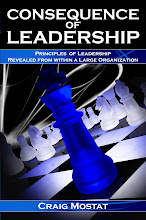
The question still remains: Why can some easily grasp the concepts of effective leadership, while it is impossible for others? From the study of past leaders – both the good and the bad, I have concluded that it has nothing to do with education, IQ, skills, ability, strengths, charisma or looks. I believe that it comes down to one simple aspect. Humility. As I define in my book - Consequence of Leadership:

Humility is best defined as being without arrogance, showing modesty and not elevating ones self above anyone else in status. Humility is not depreciating or devaluing oneself in an attempt to bring others up. It is appreciating others as much as you appreciate yourself.

Leaders of the past that have accomplished great and positive achievements, valued others as much as they valued themselves, and their objective, vision or goal transcended their own personal ambition. They exhibited humility.

In order for leaders in the future to achieve great and positive visions and goals, they will have to do the same.


Share/Save/Bookmark